2-1 Motherboard Overview
Learning Objectives
This section helps readers quickly understand the design architecture and application characteristics of the highly integrated Pandora edge computing motherboard. By covering supported modules, core specifications, expansion interfaces, display outputs, connectivity options, power requirements, and environmental specifications, users will be able to choose and deploy the correct configuration for different AI applications (e.g., intelligent transportation, machine vision, edge inference). The document also provides module performance/power reference tables, installation recommendations, and constraints to support practical development and deployment.
Pandora Motherboard Summary
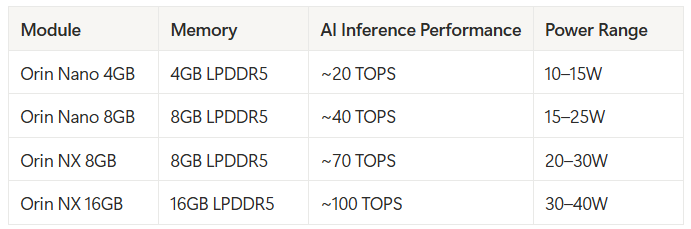
Pandora is a highly integrated edge computing platform that supports NVIDIA Jetson Orin series modules (Nano 4GB / 8GB, NX 8GB / 16GB). It provides abundant high-speed expansion interfaces and an industrial-grade design, making it suitable for AI machine vision, intelligent transportation, and edge inference applications.
Core Specifications
(1) Supports external PCIe NVMe SSD
(2) Pre-installed 128GB NVMe SSD (M.2 2280)
-
Memory: Depends on module configuration (LPDDR5 4GB / 8GB / 16GB)
-
OS Support: NVIDIA JetPack 6.2 or later
-
Firmware Support: Firmware upgradable; optional TPM module support
Expansion and Connectivity
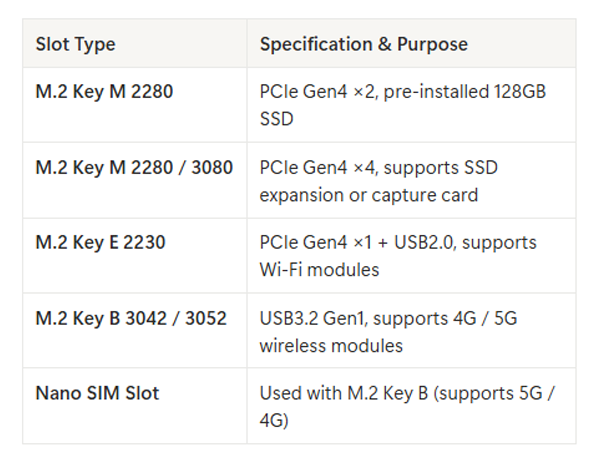
M.2 Expansion Slots (Total: 4)
Display and Multimedia
1. 1× HDMI
2. HDMI 2.0 (NVIDIA Jetson Orin™ NX Super)
3. HDMI 1.4 (NVIDIA Jetson Orin™ Nano Super)
8-lane MIPI CSI-2
D-PHY 2.1, compatible with MIPI cameras or capture cards
Audio Interfaces
-
1× Line In (3.5mm)
-
1× Line Out (3.5mm)
USB
-
2× USB 3.2 Gen2 (Type-A)
-
1× USB 3.2 Gen2 (Type-C, supports OTG)
-
2× USB 2.0 (Type-A)
Networking and Communications
- 2× RJ45 Ethernet Ports
10 / 100 / 1000 Mbps, automatic DHCP client
- 1× CAN Bus (14-pin header)
Serial Communication
-
1× UART (supports CTS / RTS)
-
1× UART (dedicated for Debug)
GPIO and Peripheral Control
1. 40-pin Header
(1) 1× I2S
(2) 2× I2C
(3) 2× SPI
(4) 1× UART
(5) 3× GPIO
2. 14-pin Header
(1) 1× CAN Bus
(2) 1× UART (with CTS/RTS)
(3) 1× Debug UART
Power and Environmental Specifications
1. Power Input: DC 12-36V
2. Maximum Power Consumption: ~42W (including module, SSD, and peripherals)
3. Operating Temperature: 0-60°C (airflow cooling required)
4. Storage Temperature: -20-80°C
Compatible Jetson Modules
⚠️ Notes and Recommendations
1. ✅ Only PCIe NVMe SSD is supported
❌ SATA SSD is not supported
2. PCIe Gen3 SSD is recommended (PCIe Gen4 SSD is compatible but will operate at Gen3 speed)
3. When installing M.2 devices:
(1) Wear an anti-static wrist strap
(2) Insert at a 45-degree angle, then secure with screws
Adapted from the original YUAN Developer Hub article. Source ID: 185.